
Integration in Real-World Scenarios
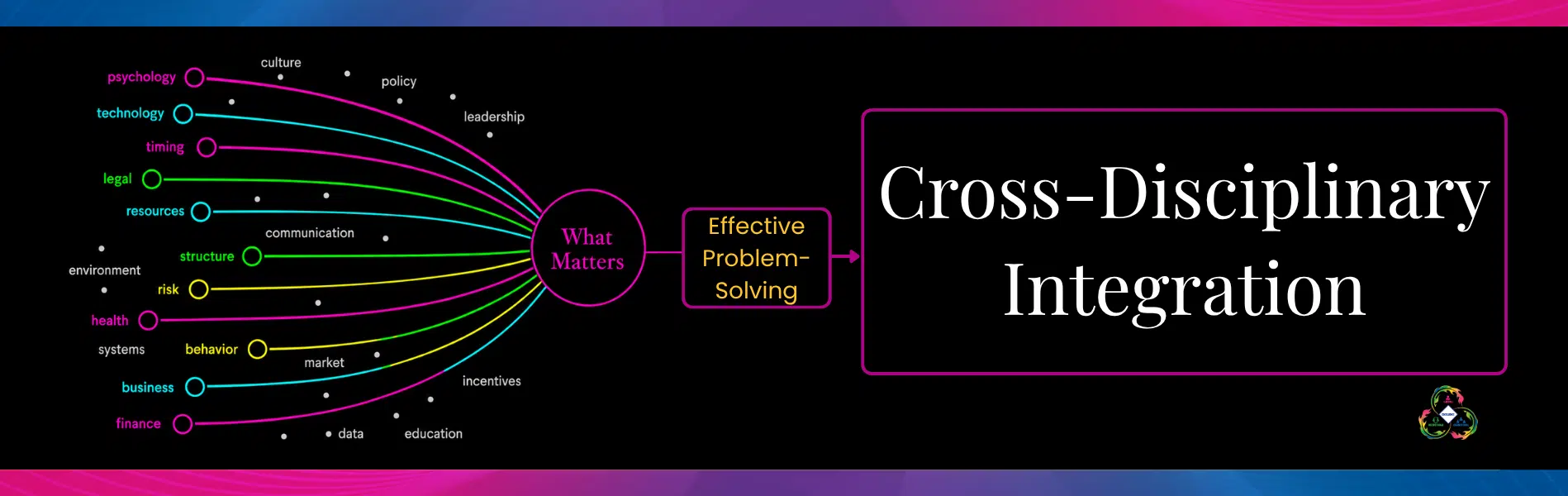
Fundamental Assumptions
1. Seeing a problem through only one knowledge lens leads to an incomplete or wrong answer.
2. Assessing the problem within its system reveals the adjacent areas that impact it.
3. Most complex problems create feedback loops across disparate domains, not just within them.
Examples of Integrated Assessment
Legal & Organizational Psychology: An attorney advises a company against firing an employee in a protected class. What is not accounted for is that the employee is toxic and is creating an exodus of talent. The company is at risk of paying one way or another. To best serve the company, the variables need to include primary and secondary legal risk (risk of the employee suing, risk of others suing), any legal strategies that will benefit the employee if they leave voluntarily, and the talent adjacent or reporting to the toxic employee. Without assessing multiple variables, the attorney can increase overall risk rather than reduce it.
Business Development, Personal Finance, and Taxes: An accountant may focus on ways in which a business can save on taxes. Adjacent to tax savings is the need to assess the amount of working capital that a business requires for reserves, growth plans, wealth management, and entity selection. Without integrating all variables, the accountant optimizes for one metric while inadvertently creating vulnerability in another.
Wellness & Psychology: A High-Achieving executive is stressed all the time. A health and wellness coach helps the executive address stress through breathing exercises, sleep hygiene, and grounding exercises while offering nutritional advice to increase her energy levels. Adjacent to wellness is the need to assess current relationships that increase stress, or conversely, feelings of loneliness or isolation, which also increases stress. Without assessing root causation, the health and wellness coach is putting a band-aid on a gushing wound.
Clinical Psychology & Negotiation: A pay out is being negotiated to avoid a lawsuit. If one focuses only on standard negotiation tactics, there will be the predictable pattern of back-and-forth and compromise. Adjacent to the negotiation underway is the fact that one party has a personality disorder. This knowledge means that he has a predictable pattern of triggers and response. Additionally, people with personality disorders have a predictable way of putting others on the defensive and stripping their confidence. Without integrating clinical psychology, the High Achiever (good person with strong ethics who want to do as he would have others do to him) is vulnerable to being taken advantage of. However, integrating knowledge of the personality pattern arms the High Achiever with both offensive and defensive tactics specifically tailored to the personality disorder, resulting in a more equitable outcome.
Quarterbacking with Adjacent Experts
I quarterback. I’m tired of witnessing myopic framing and insular expertise misapplied in ways that hurt or underserve my clients. Legal advice and process are among the areas in which I’ve seen a range of competence.
In the video below, I interview Jake Sherrard about his experience with scorched-earth litigation. Apart from describing his personal experience and perspective, he touches on some topics I’ve walked through with clients–when to fight, how long to fight, and when winning the fight feels like a loss.
Jake Sherrard's Bio
Mr. Sherrard describes himself as a recovering complex civil litigator. At some point, I asked how he knew so much about businesses. His reply was arresting. He said that the majority of his professional life has been focused on conflict and destruction. To destroy something efficiently you have to understand the “thing”. You need to know how it works, why it works, and the inherent weaknesses so that you can exploit the information. Since most of his life had been spent either trying to destroy or, occasionally, save business entities, he had to learn as much as he could about how businesses of all types work.
After decades of exploiting this knowledge in litigation, he enjoys helping people understand their businesses so that they can develop proactive strategies that increase efficiencies and streamline operations to minimize risk and conflict. In this regard, we both are passionate about helping people avoid
unnecessary pain.
Mr. Sherrard is licensed to practice law in Arizona and California and has practiced before the highest federal and state courts in both jurisdictions as lead counsel in complex civil litigation matters involving amounts in controversy of over $100 million. Mr. Sherrard is the person I collaborate with behind the scenes, and he is also available on a limited consulting basis.
Underlying Intellectual Processes of Integration
Pattern Recognition, Both Within and Across Disciplines
When I was 23 years old, I was trained in neuropsychology and cognitive assessment. This included assessing areas such as IQ, attention-deficit disorders, visual and auditory processing, and higher level executive functioning. Some areas in psychology, such as anxiety, can create the same symptoms as a neurocognitive concern.
I remember walking into the office of a brilliant mentor to show her my report. The report was about 8 pages long and represented 6 hours of testing. She read three-fourths of the front page, and said, “this is what is going on.” What she said, was the exact conclusion written on the last page. I was astounded and asked her how she knew that. I still remember her answer, “my brain picks up on certain things, and I’m like, I’ve seen this before.” That was my first introduction to the power of pattern recognition.
Integration leverages pattern recognition across psychological, business, and performance domains to identify solutions others miss. Pattern recognition also accounts for the ability to work across industries because while specific business models, products, and organizational structures may differ drastically, the underlying problems (and pathways to success) are often similar.
Example: Conflict Patterns in Family and Business
One of the unique patterns that emerges from combined expertise in psychology and business is the parallel between personal and business systems. Business partnership dynamics often mimic personal marriages; disruptive cultures often mimic dysfunctional family systems. In both parallels, an underlying conflict remains unaddressed because those involved are scared of making things worse. Hence, they develop workarounds that they perceive as less likely to break the system (silence, silent apologies, passive-aggressive coping patterns). Eventually, the workarounds become the pattern of working, even if people are unhappy.
While the parallel is most valuable for conceptualization and addressing the best entry points to change the system, the practical application is that most people can identify with various family dynamics. Using them as a metaphor facilitates understanding and buy-in for organizational interventions.
Example: Technical Debt and Process Debt
Another example of patterns across disciplines can be found in how organizations assess and respond to technical debt. Technical debt is a term in the software development space. When there is pressure for rapid development, code becomes more vulnerable to future bugs and security issues. It’s like using a credit card; get it now, pay later. The more you wait, the higher the interest. In addition to the cost of fixing the old code, there is an additional cost. The resource utilization for cleaning up the old debt competes with the creation of new and better options that may generate additional revenue.
A parallel pattern to technical debt is process debt. In a similar fashion, organizations move fast to get something done – duct taping processes together. However, at some point, they need to go back and fix the processes. In addition to the time distraction of cleaning them up, faulty processes break more things as companies scale. A third parallel to technical debt is the efficiency blind spot, where an organization cuts costs to meet a budget without fully assessing the vulnerability it creates, and then ends up fixing other breaking points in the system because of the fix.
Systems Assessment
Systems thinking enables people to focus on how parts fit together and their impact on the whole. It is the basis of good diagnostics because it enables root cause assessment rather than focusing on symptoms. It also helps prevent the mistake of making single-lens/single-factor attributions to an outcome when multiple variables interact. Systems thinking also helps people see how a solution in one area of the system can create another problem.
The combination of pattern recognition and systems assessment facilitates faster and more accurate conclusions. Systems assessment increases the likelihood of identifying the right problem, and pattern recognition provides template options from parallel scenarios to identify fixes. It enables the identification of small levers that are often overlooked when people focus on only one component of the system. Sometimes those levers are tiny actions that create outsized harm or maximum positive impact as they spread through the system.
Research Assessment
A client who integrated business and health goals expressed a desire to increase sleep. He frequently cited a book on sleep by a popular sleep expert. Some of the information he cited contradicted long-standing findings in sleep research. Digging into the original research cited in the book showed that some findings were valid and robust; other findings were exaggerated to strengthen the author’s point of view.
Unfortunately, many people are not trained in research methods and must rely on the ethics of those who cite research. This problem extends to personality assessments that are touted as “based on research.” From both an ethical and intellectual standpoint, I am committed that opinions will not be stated as facts, and one study will not be used to justify a suggestion.
It is helpful to assess apparent correlational or causative variables in a rubric of “just a hunch,” “true in some situations,” “probably true” and “definitely true.” For example, it is definitely true that social connections protect health and increase longevity. The reason it is definitely true is that not only are there many individual research studies, but there are also numerous meta-analyses (research about the research) that show both the connection and a strong impact that cannot be accounted for by other variables. This underlying scientific rigor is one of the ways the approach can identify the elements that, when integrated, are most likely to produce a positive, compounding effect.
Why Settle for Mediocre?
Being “realistic” is too often used as an excuse for being negative, staying in a rut, and maintaining the status quo. Let’s be realistic. Let’s focus on problem-solving to adjust the negative, goal orientation to maximize the positive…and see where relentless tenacity can lead us.