

HUMAN DUE DILIGENCE: The rigorous assessment of character, intellect, and judgment in high- stakes outcomes.
“I thought I could trust him. I feel…betrayed.”
“Well, they’re an expert, so I thought they knew what they were talking about.”
We’re so far down the road. It feels hard to pull out now.
The term, “Human Due Diligence” is often used in mergers and acquisitions. It’s the process of evaluating a company’s management and human capital before it’s acquired. Sometimes the term is used to capture criminal background checks or other documented risk factors in potential employees.
I believe Human Due Diligence needs a broader capture. It needs to capture the assessment of character, personality, judgment, and intellect–variables that many assume cannot be assessed or measured. Yet these variables are the ones that, when ignored, add the most risk and financial cost to business decisions.
On the other hand, for those who seek to optimize everything, Human Due Diligence can elevate entire systems. Imagine the type of positive influence and competition you feel when you are around people who are smart, fresh, grounded, focused, and fast. Now, multiply that impact and then compound it. The system itself becomes fuel for the people who are building it.
Guiding Principles of Human Due Diligence
1. Human factors drive business.
2. Humans are a primary source of risk and reward.
3. Emotions related to opportunity and scarcity create blind spots around human due diligence.
4. High Achievers, as I define them, are good people. Good People struggle the most with the ethical confounds of making critical judgments. Their character strengths lean toward fairness, compassion, and lifting others. Hence, human due diligence often appears to compete with humanitarian or spiritual worldviews
5. There is a gap in the training of business leaders on how to assess other humans. I am seeking to fill this gap.
Mergers and Acquisitions - The Genius Money Matrix
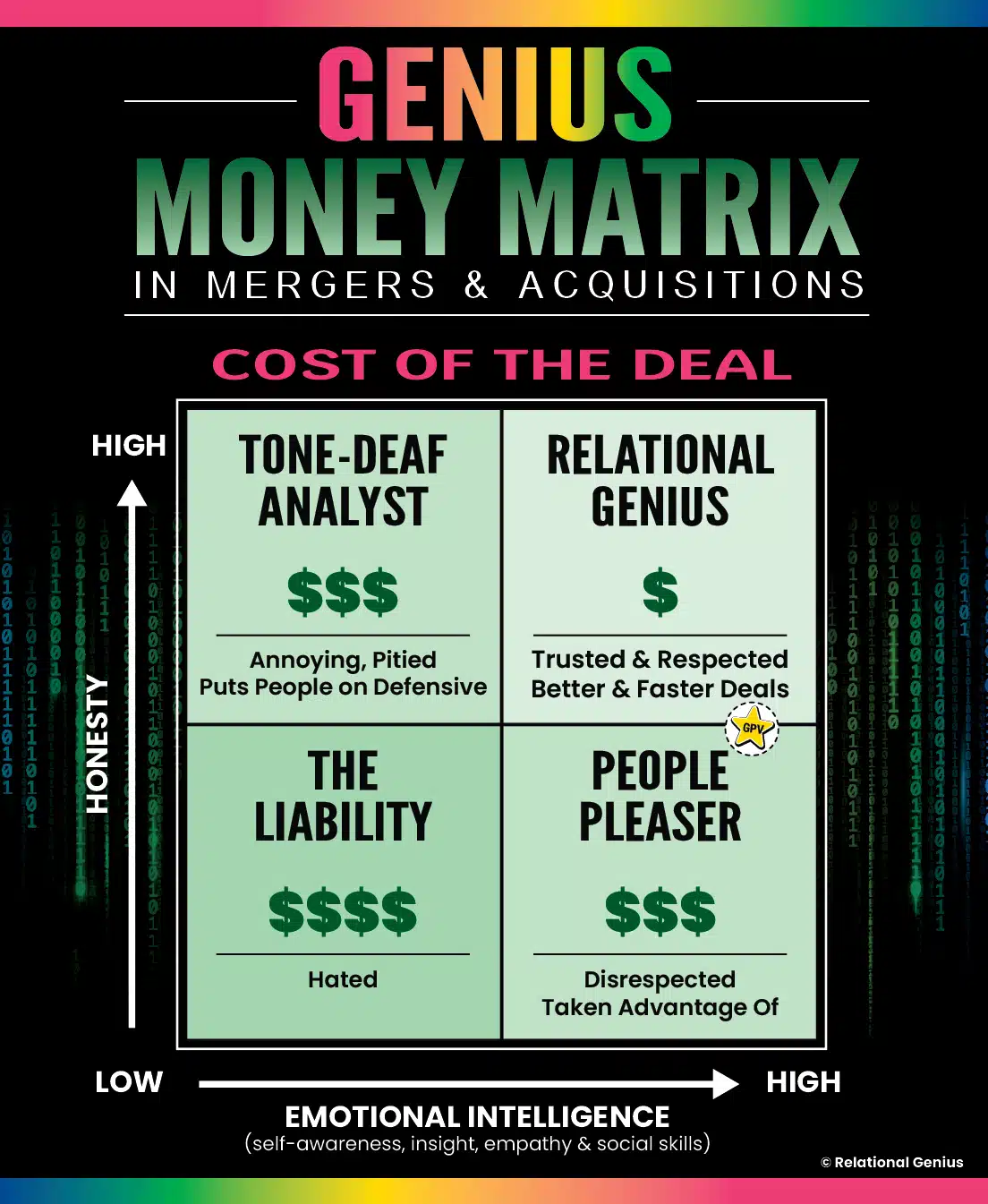
As a psychologist advising on M&A people decisions, I’ve learned that psychology partially determines deal cost, integration success, and long-term ROI. Most due diligence focuses on financials while ignoring the humans involved. Where possible, I use frameworks like the Genius Money Matrix to capture the intersecting variables of humans and deals.
A few years ago, I attended a week-long executive course on Mergers and Acquisitions at Chicago Booth Business School.
Needless to say, I was the only Psychologist in the room. However, I’d noticed the theme of chaos, bad deals, and unrealized returns over the years. Multiple people told me about integrations gone wrong.
By the third day, I was frustrated by the unnecessary money spent or left on the table. In one case, three sentences of strategic, advanced empathy would have likely saved millions of dollars.
During the course, I listened to the conversations of the executives around me. CEOs assessed whether their foundations were ready for an acquisition. Financial people assessed deals from discounted cash flow. Business development people assessed the strategic value for market domination.
Most of the people in the room were on the acquisition side of the equation. When I asked about the due diligence habits of companies being acquired, I learned that many didn’t have experience and were easily taken advantage of.
I explained to one of the instructors, who had led many deals, that the discussion missed fundamental variables that impacted outcomes.
In my desire to begin a conversation about the human factors that impact the financial cost and/or return on investment of M & A, I mapped out this matrix on the back of a piece of paper.
Board Members Selection
Questions to Guide Board Member Selection
1. What is the overt, stated function of the board? What are the covert expectations?
2. What are the non-negotiable guiding values of the organization? Why specifically do you exist, and what are you trying to achieve?
3. In rank-ordered priority, what do you want from board members? What do you not want?
4. How much involvement and precisely what type of involvement do you want from board members?
The Board is already established....and it's dysfunctional.
1. Have a “reset” conversation that opens the door for changes that need to occur to increase alignment with the vision. One can frame it as a periodic review to ensure that the board is functioning well and that everyone’s time and resources are respected.
2. Leverage the Power of the Group
It only takes one voice of dissent to break group conformity. When someone is willing to do this, others who have stayed silent will come forward. With strategic planning, one can orchestrate group dynamics to silence dysfunctional behavior.
The Cost of Human Due Diligence and Active Inaction
There is a theme that underlies the money I've turned down over the years. On some days I'm proud of it, and on others I wish I were a little less smart and a little less intuitive. My ability to rapidly see people is one of my greatest gifts. Yet there is a cost. The...
Related Reading: Dealing with a Difficult or Toxic Board Member
Business Partner Selection
Even in ‘business as usual’ circumstances, the health of the partnership will impact the level of personal satisfaction and success in the business. The person you were excited to work with becomes your work spouse, with parallel stories of happily-ever afters or messy divorces.
From a business viability standpoint, potential business partners often underestimate the degree to which the relationship between partners will drive the outcome of the business.
HIgh Achievers often take shortcuts on partner due diligence. They assume that “good people” will abide by the same ethical code as they do. Even when this is true, potential partners who slack off on due diligence to align on the vision, operations, and business exit jeopardize its potential. Often, these small misalignments create cracks. With the fuel and pressures of business growth, they become fissures.
Tips to Assess the Viability of a Partnership
1. If a significant other or friend who knows you well has concerns about your potential partner, take them seriously. They know you well and may see beyond the upsides of the opportunity lying in front of you.
2. Talk with the potential business partner about your past professional relationships that went well and those that didn’t. Assess work styles and personalities that impacted your happiness. Depending on your comfort, I can guide you through this process.
3. Tiny character concern? Don’t excuse it, don’t dismiss it, and don’t justify it. Money, ego, and power will magnify cracks.
4. Discuss assumptions and views on work availability, risk tolerance, and financial debt.
Related Reading: Co-Founder and Business Partner Relationships
Hiring and Firing
Hiring Mistakes
♦ Developing a bias and attachment toward a prospective employee based on the resume
♦ Giving too much grace for nerves, timeliness, or other slip-ups
♦ Putting too much weight into “who you’d want to have a beer with.”
♦ Failure to screen for cognitive capacity & processing
♦ Minimizing the impact of personality or character concerns.
♦ Assuming that in times of desperation, a body is better than nobody
When to Give Grace in Interviews:
The higher the position level, the less room there is for grace. In higher-level positions, you will likely need people to have their ducks in a row and show up to play regardless of nerves or circumstances. Even in lower-level positions, a candidate’s timeliness and reliability matter. Don’t make excuses for them.
Potential employers usually know when grace is needed. They don’t have to think about it. A clear and present life situation generates empathy (a crisis). This information can even be used to assess a candidate’s communication during times of stress.
Firing Mistakes
♦ Not clarifying for both you and the employee what needs to change
♦ Trying to coach a characteristic that cannot be coached
♦ Giving the benefit of the doubt without a specific end point
♦ Viewing any employee as indispensable
♦ Trying to get it exactly right
♦ Doing it alone if you don’t have to
Decrease Firing Mistakes
♦ List the number of chances, conversations, or problems that have occurred to date. Is there data to suggest the pattern will change?
♦ What does the business need?
♦ Who will be impacted if you attempt to coach or reposition them?
♦ How would you feel if they won the lottery and quit tomorrow?
♦ DO NOT BE TRANSPARENT WITH DIFFICULT PEOPLE.
♦ Assess risk from all sides, not just potential litigation risk.
Making Soft Skills Measurable
Character, reliability, personality and growth concerns are some of the most common reasons to fire employees. Yet, these are often not accounted for or documented in quarterly or annual reviews. The lack of documentation typically results in a 6-month delay between the decision and HR-legal support. Measuring soft skills as part of a process helps all employees, improves clarity, and increases speed of execution when a decision is made.
360 Feedback, 1:1, Performance Reviews
Use a 360 mode of obtaining feedback from peers, subordinates, and supervisors. Likert scale ratings (0-5) provide the quantification that is necessary for tracking progress or lack thereof.
Integrate specific soft-skill or leadership development tracking into the rubrics for 1:1s or quarterly reviews. This allows soft skills to become business as usual discussions.
Track and Document
Set up a system for tracking problems and use it consistently. If you have a warning system for hard skills, it is necessary to have one for the soft skills as well. It may be the same system or a different one. Build in enough flexibility and a system for extenuating circumstances and genuine problems.
Personality Disorders & Other Difficult People
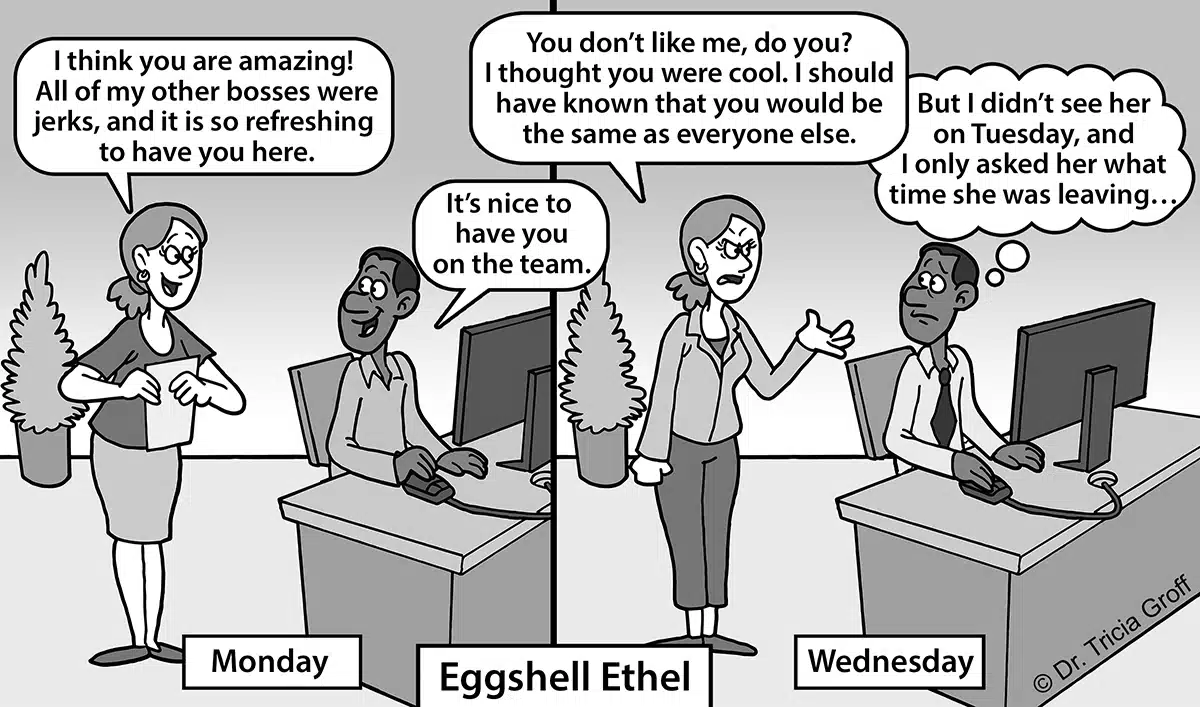
Questions to assess if you are dealing with a difficult person
- Do I feel like every conversation will be a circular diatribe about how it’s someone else’s fault?
- Do they have unrealistic expectations but make me feel like I am mean or selfish if I don’t accommodate them?
- Do I dread conversations because I’m left completely drained, with no positive outcome?
- Do I feel like this person is trying to “pull” something out of me or elicit some type of reaction?
- Do I have notebooks of documentation but still feel like maybe I’m the one doing something wrong?
Fundamentals of Dealing with Difficult People
1. The other person is unlikely to change.
2. Handling them the way you have in the past 50 conversations will not yield different results.
3. You CAN be assertive and kind at the same time.
4. Conversations to help them see your point of view is a waste of your time.
5. You will probably offend them.
6. Strategic actions are more effective than conversations.
High Achiever Vulnerabilities
1. High achievers can under-estimate the toxicity of difficult people, many of whom have personality disorders. People with personality disorders can be very intelligent and competent. As a result, many high achievers overlook the red flags.
2. High achievers who are nice and reasonable assume that this approach wins the game. It does with rational people. It makes you a target in toxic situations.
3. High Achievers want to be fair, so they give grace too early for good behavior. The difficult person perceives “grace” as successful manipulation.
Related Reading: Part IV: Toxic Games, Relational Genius Book
You cannot have a rational conversation with an irrational person.