

High Achiever Characteristics

PERSONALITY TRAITS
“My expectations seem realistic to me.”
- High sense of personal responsibility
- Honest, almost to a fault
- Action and solution-oriented
- Hates incompetence
- High expectations that seem normal
- Hard on self-easy to feel like failure
- Internal competitive streak
- Insatiable curiosity
- Craves time to think
- Excellence has no ceiling
INTELLECTUAL TRAITS
“Why am I the only one who sees this problem?”
- Processes information quickly
- Able to see patterns
- Synthesizes across disparate domains
- Extrapolates the main points quickly
- Tedious, irrelevant detail makes you tired
- May speak fast
- Gets to the right answer quickly, almost intuitively
- Identifies problems 6 steps out that others don’t see
- Values critical thought

Responsible - A Double Edged Sword
One of the best characteristics of High Achievers is their high integrity. They take responsibility for their actions and outcomes. This trait helps them develop strong relationships and a good reputation. At the same time, it can create emotional difficulty because High Achievers tend to take responsibility for things that are not their fault. The tendency to take all blame on themselves creates an emotional drain and can also inhibit problem-solving. A solution to help sort through the variables that contribute to less than desirable outcomes is to draw a pie and assign the responsibility across multiple variables. This visual representation provides a more accurate view of what they need to change versus relationships that may need to change or situational variables that were outside their control.
Interpersonal Traits of High Achievers

INTERPERSONAL STRENGTHS
“Everyone relies on me!”
- Cares deeply about people, even if people exhaust them
- Loyal
- Takes commitment seriously
- Values substance over social pretense
- Prefers straightforward communication
- Eager to help and problem-solve
- Perceived as very competent
- Natural leader
INTERPERSONAL CHALLENGES
“Everyone relies on me…”
- Tendency to overestimate others’ competence
- Balancing directness with others’ emotional needs
- Finds small talk exhausting
- Hates disappointing others
- Dislikes asking for help
- Thinks they should be able to change people (doesn’t work)
- May rely on logic to resolve emotional arguments
Organizational Leadership Traits of High Achievers

ORGANIZATIONAL STRENGTHS
“I can see exactly what needs to happen!”
- Excellent at seeing gaps in vision
- Able to identify system inefficiencies
- Seeks progress; hates stagnation
- Values organizational success over ego
- Stressed by political maneuvering
- Focuses on innovation and growth
- Fueled by strategic thinking
ORGANIZATIONAL CHALLENGES
“I can see exactly what needs to happen…”
- Difficulty delegating when others don’t meet standards
- Overestimating team members’ capabilities or understanding
- Balancing desire for excellence with pragmatic timelines
- Finding advisors and board members who add value
- Experiencing isolation at the top of the organization
- Frustrated with employee incompetence
- Struggles with determining reasonable expectations
Additional Information for High Achievers
Reframing "Weakness" - Shadow Side
Many High Achievers are hard on themselves when they encounter an area of “weakness.” Carl Jung was a psychoanalyst who use the term “shadow side” to describe the parts of people’s personalities that they try to repress compared to those aspects of which a person is consciously aware. While Jung used the term to focus on subconscious areas of personality, I’ve borrowed and repurposed it to represent the flip side of our strengths.
Foundational Concept: The shadow side exists because of strength.
Most strengths have a cost attached, a shadow side if you will. For example, generous High Achievers may struggle to set boundaries around how much to give others. Alternatively, a 2SD, humble High Achiever who wants to see the best in people and help them win may struggle with when to fire them. Super-responsible high achievers take responsibility for things outside their control, creating additional stress on themselves. Finally, the High Achievers with high standards of execution may have difficulty recognizing what “good enough” looks like (I’m still clueless).
How to Fix It.
Identifying which strengths create your areas of struggle. Make a list of weaknesses and think about whether they are a byproduct of an area of strength. This exercise often reduces feelings of failure and shame. Once you see the relationships, focus on celebrating the upside, managing the shadow side, and giving yourself grace along the way.
Unique Personality Challenges
Sometimes being a High Achiever creates distinctive, and often, paradoxical, challenges.
The Optimization Paradox:
For High Achievers, self-discipline usually means figuring out when to do less. The drive to do more can increase vulnerability to unfulfillment and burnout. The answer isn’t precisely about doing less, but rather incorporating guardrails into the achievement paradigm.
The Responsibility Trap:
High Achievers’ natural tendency to take ownership makes them incredibly reliable and trustworthy. However, they also tend to take responsibility for outcomes outside of their control, which increases stress and fatigue.
The Authenticity Challenge:
Most High Achievers have learned “hold back,” either because they’ve been misunderstood or in order to work effectively with others. While that response shows adaptability, it can also make it difficult for High Achievers to feel like they can be themselves.
The Support Scarcity:
High Achievers generally don’t ask for much help. Sometimes it’s because they hate asking. At other times, it’s because they are uncertain that competent help is available. Often, they don’t think about asking for help because they are used to problem-solving independently. Together, it can be difficult to obtain the type of support that truly lightens the load.
2 SD Intelligence
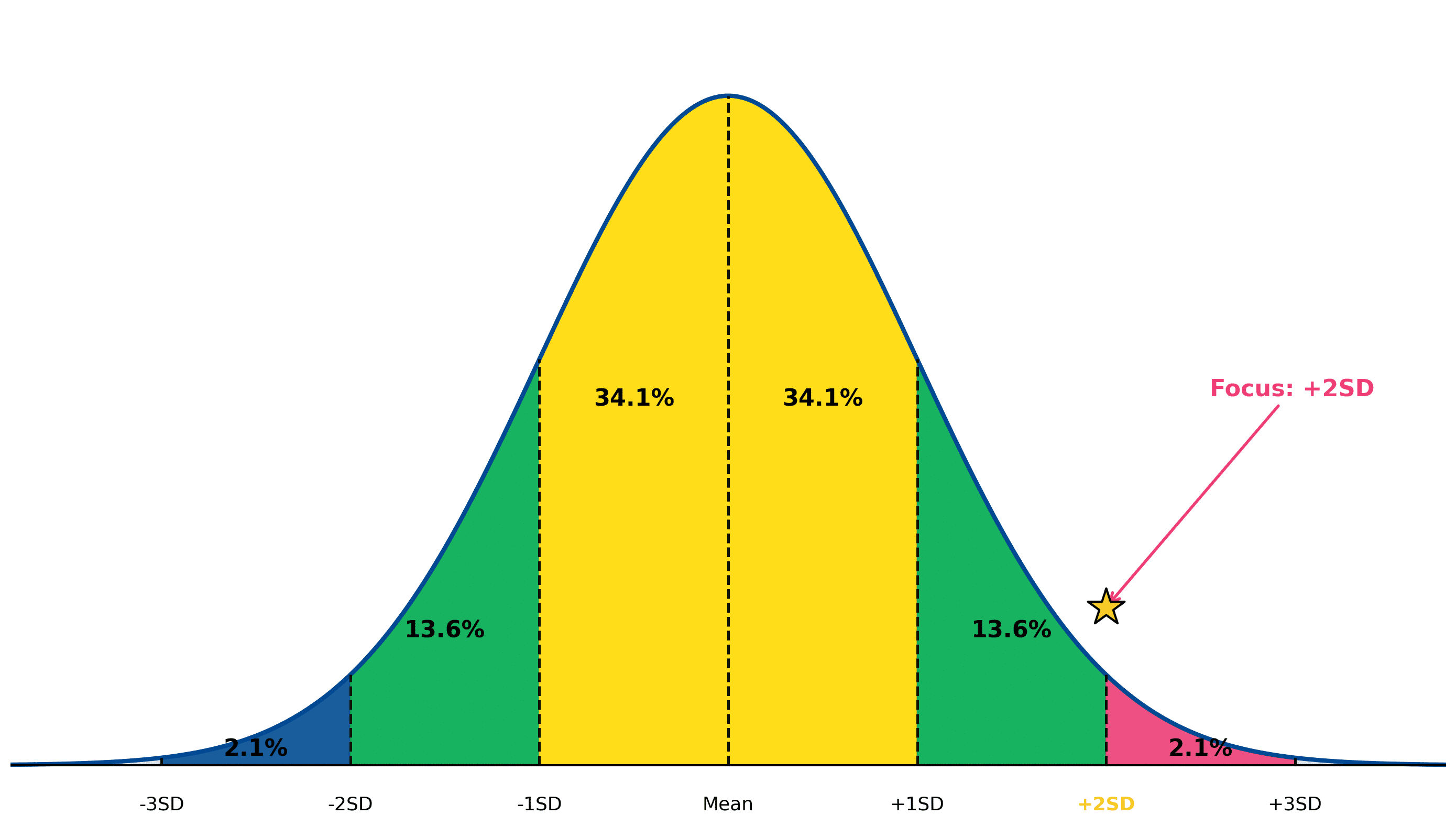
2SD refers to a percentage of the population that is 2 standard deviations to the right of the statistical normal curve. You may or may not perceive yourself as unusually intelligent. Some smart people got bored in school or had ADHD, such that their intellectual skillsets were overlooked. Some 2SD High Achievers were in advanced classes in school; some may have been tested for IQ. What matters is knowing that when your intellectual patterns are different from the rest of the population, it can be especially frustrating to understand how other people think (or don’t think).
Most High Achievers Seek...
To feel understood
Specific tools and strategies
To not feel alone
To be respected
Results
Progress
To feel confident about decisions
Meaning and fulfillment
To be authentic
Confidence
Peace and reconciliation within oneself
(And if at this point you’re thinking, doesn’t everyone want these things? Yes, but to a lesser degree. It’s like this–many people like to learn, but High Achievers crave intellectual stimulation. It’s similar to other characteristics mapped on a bell curve. It’s the amount or extent that creates the difference rather than a categorical delineation.)
Am I Normal?
“I wonder if I’m getting it right. I think I’m right, but maybe I’m the crazy one.”
How I Found My People
Reverse-Engineering High Achievers. One week, I’d noticed an odd pattern. I had several days with just a few clients, but I was exhausted at the end of the day. There were other days, with many clients, where I was exhilarated at the end. Curious, I developed an energy grid with an energy assignment of -3 to +3. I wrote down each name and assigned a number that corresponded to the pattern of energy drain or gain that occurred after each session. I then looked at the commonalities among clients who were energy-neutral or energy-positive. That exercise led to a hypothesized list of characteristics. Since my mentor had inculcated in me the value of research, I developed the characteristics into a survey and gave it to everyone who seemed to fit the profile. The results formed the initial list of characteristics, which I refined as I saw more high achievers.
2SD Intelligence. It took me longer to arrive at the 2SD intelligence specialization. I’ve never wanted anyone to feel rejected or not good enough. Further, our culture shies away from owning intelligence as a characteristic, even though we easily comment on hair color or height. Honestly, what I noticed first was for my benefit. I felt like I could be myself with the 2SD clients. They instantly “got me” and often finished my sentences. On their side, they seem to get a great deal of value from working with me, making it highly rewarding for both of us. The unexpectedly cool outcome is that they make me better. I’m constantly listening, learning, and researching to stay ahead of where they’re going. And because they span industries and experiences, I end up sharpening my knowledge base, which creates cross-pollination of learning for everyone.

Profiles of High Achiever Clients
(Names Have Been Changed to Protect the Innocent)
Angie, The Fun and Contrarian Founder
Angie is a founder and owner of several companies. She is a visionary who builds and creates. As a human, she is warm, honest, and unwilling to settle for the status quo in any facet of life. She leads with both intellect and passion, always seeking to empower others’ success.
Kyle, The Young Einstein
Kyle is a founder and executive of a VC backed company that is rapidly expanding its territory. He quickly implements new strategies, and he embodies the commitment to whole-person excellence. Kyle sometimes spices up a serious conversation with sarcasm that leaves one laughing for hours.
Al, the Emotive Math Genius
Al is a C-suite executive who synthesizes information at the speed of light and is an early adopter of all good ideas. He is an amazing human, who seeks peak performance in himself and his team. He works hard to balance high expectations with compassion and flexibility.
John, The Dry-Humor Entertainer
John is the owner of a rapidly growing business that is in the teenage phase. He is funny, easy-going, and whip-smart. John is strong-minded and open-minded, so he’ll consider new paths if the argument is solid. He continuously strives for business and personal excellence.
Brent, Crunchy on the Outside; Gooey on the Inside
Brent is a specialist and leader in the health industry. He is brilliantly logical and prefers any explanation of human behavior to be translated into a flowchart with supporting rationale and applicable examples. Brent is funny, willing to tolerate extreme discomfort, and remains uncompromising in his dedication to excellence.
Lisa, The Pattern Connector
Lisa is a senior executive in a company that innovates at warp speed. She sees connections and patterns that others don’t see; so she constantly works to contain chaos without slowing the growth. Her dedication to excellence in unrelenting, which usually means that she’s hard on herself.